
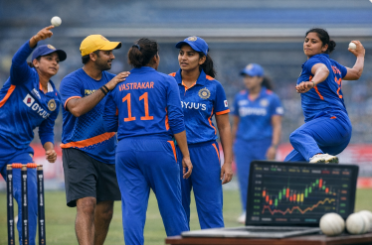
Women cricket India T20WC preparation has taken a surprising turn as India Women’s Cricket Team continue testing multiple bowling combinations ahead of the ICC Women’s T20 World Cup 2026. The decision to rotate options this late in the build up highlights a deliberate push for flexibility rather than settling early.
For cricket betting markets, this creates immediate uncertainty around team balance and performance projections. And that uncertainty is exactly where the story begins to get interesting.
Reading time: 3 minutes
The Late Experiment That Changes Everything
India’s decision to keep experimenting instead of locking a final bowling unit is the defining moment in this phase of preparation. Rather than committing to a fixed structure, the focus remains on testing combinations across different match scenarios.
For cricket betting, this matters more than it first appears. Cricket teams entering major tournaments without a fully settled attack often produce fluctuating outcomes, especially in T20 tournaments where execution margins are tight. Early cricket odds may still reflect India’s reputation, but underlying variability is increasing.
This is not instability, it is controlled experimentation, but the market does not always price that correctly.
Why This Strategy Could Either Work Brilliantly or Backfire
The balance between pace and spin remains the central question. India are clearly exploring how to optimise that mix depending on conditions, which is a logical approach in global tournaments.
However, in cricket matches, constant rotation can disrupt rhythm. Bowlers build control through consistency, and frequent changes can affect execution in key phases such as the powerplay and death overs.
For betting markets, this directly impacts totals and scoring patterns. Matches involving India may now carry wider variance, making innings projections less predictable and increasing volatility in cricket odds.
The Hidden Betting Edge Most Are Ignoring
The market often interprets experimentation as depth, but it also signals that roles are not fully defined. That distinction creates opportunity.
Cricket betting apps tend to favour teams with perceived stability. India’s continued rotation challenges that perception. If odds remain anchored to reputation rather than current structure, there is a gap.
This is where informed bettors gain an advantage. Recognising that flexibility does not always equal consistency allows for sharper decision making, particularly in match specific conditions.
Players Under Pressure as Roles Remain Unclear
With multiple bowlers being tested, individual roles are still evolving, and that is becoming visible in recent warm up matches and preparation fixtures involving the India Women’s Cricket Team during their build up to the ICC Women’s T20 World Cup 2026. Senior names like Deepti Sharma and Pooja Vastrakar are being used across different phases, while options such as Renuka Singh continue to handle new ball responsibilities depending on match conditions.
This directly affects performance bets, especially in top bowler markets where clarity is everything. When roles shift from match to match, consistency becomes harder to predict, even for established players.
In women cricket, role definition often drives reliability. When bowlers like Deepti Sharma move between containing roles and attacking spells, or when seamers are rotated based on matchups, predicting standout performers becomes more complex. At the same time, certain cricket players can gain an edge depending on opposition weaknesses and pitch conditions.
For betting markets, this increases the importance of confirmed team selections and match specific tactics rather than relying purely on historical data. In matches leading into the tournament, these subtle role adjustments are already influencing how cricket odds behave, especially in tightly contested fixtures where small tactical shifts can decide the outcome.
What This Means Going Into the Tournament
Women cricket India T20WC preparation suggests that the final combination is still being shaped. This means betting markets are likely to remain cautious until clearer patterns emerge.
Opposition teams may look to test these combinations early in matches, particularly in high pressure situations. If India’s flexibility translates into adaptability, it becomes a strength. If not, it introduces risk.
Cricket predictions at this stage must account for this balance between potential and uncertainty.
How This Impacts Betting Markets and Future Matches
Women cricket and T20 tournaments are heavily influenced by momentum, and India’s approach adds another layer to that dynamic. In cricket betting sites, teams still experimenting often produce sharper swings in live odds.
Live odds behaviour becomes critical here. Early success or failure in execution can quickly shift match projections, creating opportunities for those tracking games closely.
For cricket predictions, the focus shifts toward adaptability and in game decision making rather than pre tournament assumptions. Volatility is now a defining factor.
Final Take
This is not just preparation, it is a calculated gamble. India’s willingness to experiment could unlock the perfect balance at the right time, but until that happens, uncertainty will follow them into the cricket tournament.
Disclaimer: Responsible gambling is essential when engaging with cricket betting markets. Set clear limits, avoid chasing losses, and recognise that live odds can change rapidly based on match situations. Always approach betting with discipline and informed judgement.

Macaela Becker
Macaela is an iGaming writer who covers sports betting, casino platforms, and industry news. She researches betting markets, odds, and bonuses to create clear, practical guides.
She focuses on helping you stay informed while making betting easier to understand.


